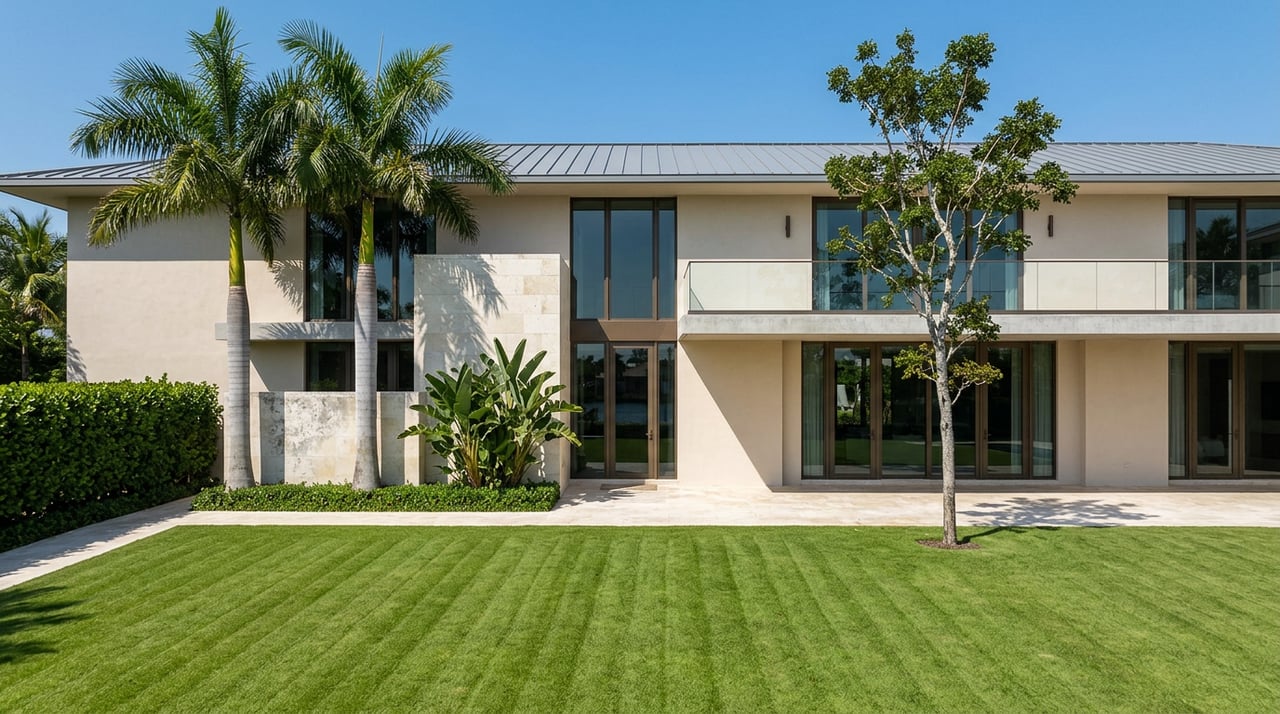
How do you write a purchase contract for a house that doesn't have a certificate of occupancy yet, on a lot that costs more than most cities' annual budgets?
That was the actual problem facing lawyers on both sides of the $170 million sale at 7 Indian Creek Island Road in March 2026, the transaction that became Miami-Dade County's most expensive residential closing on record. Mark Zuckerberg and Priscilla Chan bought a two-acre waterfront parcel, still under construction, designed by Ferris Rafauli, from sellers who had acquired the raw land for roughly $30 million back in 2020. The house had been listed at $200 million before it traded. It closed at $170 million, unfinished. It cleared the previous county benchmark, a $120 million Star Island estate sold by developer Vlad Doronin in 2025, by fifty million dollars.
Most of what's been written about that sale treats it as a data point about wealth concentration on a private island. It is that. But the more useful read, for anyone trying to understand what actually sets prices on Indian Creek, is what the sale had to be structured around: not square footage, not a finished product, but a construction schedule and a set of representations about what had and had not been built yet.
A Mid-Build Sale Carries Risks
That is not a footnote. It is the reason a Florida real estate attorney and a title company with genuine high-value island closing experience matter more on Indian Creek than almost anywhere else in South Florida. A mid-build sale carries risks a finished-home sale doesn't: unresolved permitting, subcontractor liens, design changes still in motion, and a buyer inheriting a project rather than a product. The fact that this kind of deal can close, and at a record price, tells you the market has learned to price construction status as its own variable, separate from land and separate from the finished square footage everyone assumes is driving the number.
The Sixty-Five Million Dollar Gap Nobody Puts in the Comp Sheet
Here is where the headline number stops making sense unless you separate it into pieces. On the western side of the island, where lots run closer to 80,000 square feet against the island's more typical 50,000-square-foot norm, comparable raw land alone was valued at roughly $105 million in 2025. The Zuckerberg-Chan purchase, on a comparable-caliber site, closed at $170 million for a home that wasn't finished.
The gap between those two numbers, roughly $65 million, is not a mystery premium. It's the price of design, a permit set already in motion, construction progress already banked, and a buyer's willingness to pay for a compressed timeline instead of starting from bare land and waiting years for a Rafauli-caliber build to reach the finish line. On an island where the buyer pool skips over ordinary financing timelines and cares more about occupancy dates than interest rates, that gap is arguably the most important number in the entire transaction, more important than the $170 million headline itself.
A rough way to see how differently the market treats these three transaction types:
| Sale type | What's actually being priced | Example |
|---|---|---|
| Raw land assembly | Frontage, lot size, orientation | ~$105M land basis, 2025, western parcel |
| Off-market resale of a finished home | Land plus existing condition | $64.5M trade at 40 Indian Creek |
| Mid-build trophy sale | Land, design, progress, delivery speed | $170M, 7 Indian Creek Island Road, March 2026 |
Three different products. Three different pricing logics. Treating them as one market, the way a single median or price-per-square-foot figure would, erases the exact information a buyer or seller needs before writing an offer or setting an ask.
The Trades You Never Hear About
There's a second distortion sitting underneath the first one. Indian Creek has roughly 41 home sites, and by most market accounts, something close to half of all transactions on the island close off-market, through private representation, with photography restrictions and pre-cleared guest lists standing in for a normal showing process. Those deals never generate a public listing history, so the visible sales record (the ones that produce headlines like this one) is not a random sample. It skews toward whichever sellers, for whatever reason, needed or wanted visibility.
That matters for anyone trying to use recent Indian Creek sales as a benchmark. Since mid-2023, no arm's-length public sale has closed below $64 million. That floor is real, but it's a floor built from the half of the market that goes public, not the whole market. The other half, structured quietly, may be pricing differently in ways nobody outside the deal will ever see reflected in a comp sheet.
What the Bridge and the Badge Are Actually Pricing
None of this happens in a vacuum. Indian Creek Village is a self-governed municipality, roughly 294 acres according to the Village's own government site, connected to the mainland by a single span, the Surfside Bridge, and served by its own Public Safety Department rather than a contracted security firm or county patrol. The island wraps around a private 18-hole golf course, so homes sit on the perimeter with water on one side and very few neighbors on the other. There is no commercial strip and no through traffic, because there's no reason for anyone to be there who doesn't live there.
That structure is not incidental to the pricing. It is arguably a bigger driver of the $64 million floor than any individual house's finishes. A buyer paying eight or nine figures on Indian Creek is paying, in part, for a jurisdiction that runs its own government and its own law enforcement, screens every vehicle at a single checkpoint, and answers to a village council made up of its own residents. That last detail is worth sitting with: this is a community where an owner can sit on the body that governs the police force protecting the street they live on. It's a level of control over one's own environment that a gated community, however well-run, structurally cannot replicate.
The Village was still working through routine business as recently as this month, with a fiscal 2026-27 budget hearing that had been scheduled for its council in early September. That's a small, unglamorous fact, but it says something the celebrity roster doesn't: this is an active, functioning municipal government, not a marketing concept. The governance is the product as much as the water frontage is.
What This Means If You're Deciding When to List
For an owner weighing whether to bring an Indian Creek property to market mid-construction versus waiting for a certificate of occupancy, the Zuckerberg-Chan sale offers a real answer, not a headline. Waiting for completion carries carrying costs, construction risk, and market timing risk. Selling mid-build converts a project into cash sooner, but only if the buyer pool is willing to underwrite construction status instead of a finished product, and only if counsel builds the contract to match.
For a buyer evaluating a raw parcel against an assembled or partially built compound, the lesson is similarly specific. The land is not the ceiling. The design, the permit progress, and the delivery timeline sit on top of it, and on Indian Creek that stack has recently been worth tens of millions of dollars on its own.
FAQ
Is the $170 million sale representative of what a typical Indian Creek home costs? No. It represents the top of a specific transaction type, a mid-build trophy sale. Off-market resales of already-finished homes, like the $64.5 million trade at 40 Indian Creek, price on a different basis: land plus existing condition, not delivery speed.
How many homes are actually on the island? Roughly 41 home sites ring the island's private 18-hole golf course, on a municipality of about 294 acres connected to the mainland by a single bridge.
Understanding how a market like this actually prices, not just what it costs, is the kind of groundwork that matters before a listing goes live or an offer gets written. If you're weighing a move in this segment of South Florida, Bryan Halda and The Halda Group are glad to talk through what a specific property or timeline is really worth before you commit to a number. Let's Connect.
This article is general information, not legal, tax or financial advice. Consult a qualified professional about your situation.